A Modern Approach to Teaching an Introduction to Optimization
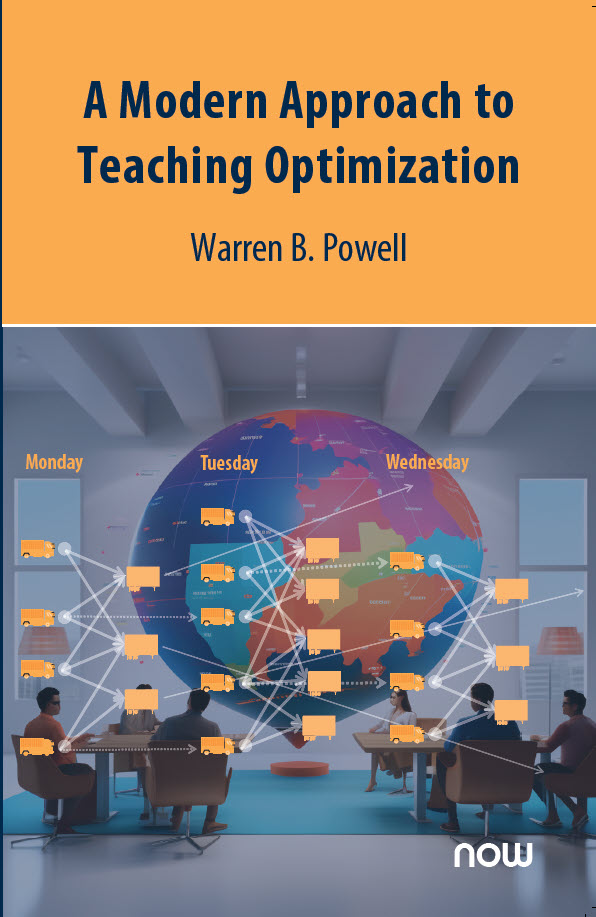
This is a web edition of A Modern Approach to Teaching an Introduction to Optimization, read directly in your browser rather than as a PDF.
The book is also available as a downloadable PDF, or see the book’s webpage for a fuller overview and additional readings.
“Optimization” is widely taught in departments such as operations research, industrial engineering, and sometimes applied math, as focusing on complex, multidimensional (and often very high-dimensional) problems that can be formulated as linear, nonlinear or integer programs. Introductory courses are often centered on linear programming, the simplex algorithm and duality theory.
“Optimization” should be the study of making good decisions, and should start with the simplest (but nontrivial) decisions that are familiar to every student. Linear programs solve a very tiny fraction of decision problems, even in areas such as business where linear programming is often taught. I will note that almost no-one in business without formal training in linear programming has even heard the term. More distressingly, only a fraction of undergraduates or masters students who take linear programming ever solve a linear program (even with a package). And no-one outside a tiny core of specialists has ever programmed the simplex algorithm.
This book is aimed at faculty who are already teaching an introductory optimization course, or who have a background in optimization and are designing an optimization course. It is also useful to anyone with conventional training in optimization, since it will show you how to think about optimization differently. The presentation consists of a set of topics to guide the design of lectures, leaving considerable flexibility in terms of how much emphasis is placed on individual topics.
Published: 1st edition, NOW Publishing, June, 2025.
Reprinted online: July, 2026, at warrenpowell.org.